




It's a fair and important question. A number on a dashboard is only useful if you understand what it is telling you. With that in mind, we've made meaningful updates to how the Pathogen Risk Score is calculated, making it a more reliable tool for tracking disease risk over time.
What Changed and Why It Matters
The Pathogen Risk Score previously relied on raw pathogen abundance to generate an overall risk estimate. This approach treated every pathogen the same, regardless of whether a given level was unusual or expected for that microorganism. The updated score now works similarly to our Alert Levels. Rather than looking at abundance alone, it compares the levels of each pathogen on your dashboard against our historical benchmarking data. A pathogen must be elevated relative to what we typically observe across similar operations before it meaningfully contributes to your risk score. In practice, this means the score is now more sensitive to real departures from normal, and less likely to be influenced by background levels that are simply part of normal variation in the poultry microbiome.
How to Read the Updated Score
The Pathogen Risk Score is now reported on a scale from 0 to 1.0, with three categories:

A higher risk score can reflect either a single pathogen that is extremely elevated, or several pathogens that are all running above their individual baselines at the same time. As always, the risk score is a signal, not a diagnosis. It should be interpreted alongside flock history, clinical observations, and with veterinary input.
The Pathogen Risk Score in Practice
Example 1: Sustained Risk in a Layer House with Elevated Mortality
A commercial layer operation had been experiencing slightly elevated mortality for several weeks. It wasn’t high enough to start testing with traditional diagnostics, and individual pathogen alert levels would come and go, including recurring medium alerts for Mycoplasma gallisepticum and a couple of medium alerts for Clostridium perfringens.
What the updated Pathogen Risk Score helped surface was a more complete picture. Even though there wasn’t a clear outbreak, multiple pathogens were running consistently above their average baseline levels, potentially causing ongoing low-level mortality. The updated pathogen risk score captures the aggregate burden of disease. This information supported ongoing veterinary monitoring, prompted a closer review of management conditions, and resulted in the implementation of a probiotic to help support the hens in this barn, even in the absence of a single definitive answer causing the mortality.
This information doesn't replace clinical judgment, but the data support it. When the numbers consistently point to increased pathogen risk, that pattern deserves attention.
Example 2: Placement Alerts That Resolved Over Time
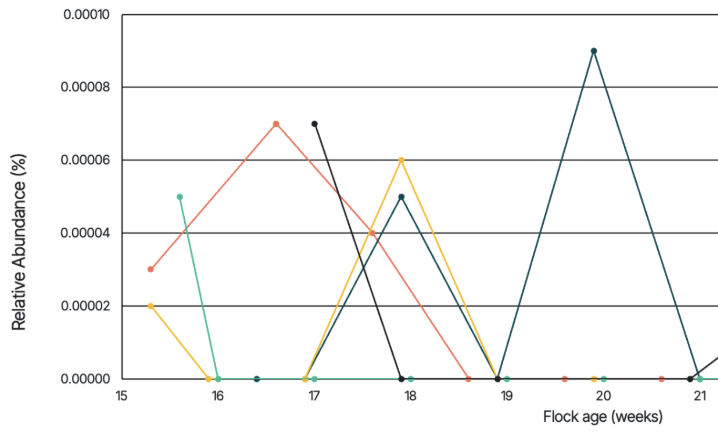
A pullet operation with ongoing disease challenges submitted a sample prior to bird placement. The result showed a cluster of pathogen alerts, which were elevated across several organisms. This resulted in a medium Pathogen Risk Score. At first glance, this was concerning.

However, context matters. This sample was taken prior to cleaning and disinfection and therefore identified the pathogens that were likely plaguing the previous flock. As the current flock settled in and subsequent samples were collected, the alerts resolved, and the Pathogen Risk Score steadily declined toward the normal range. That trajectory confirmed that the initial signals were likely environmental contamination that was removed and killed during cleaning and disinfection.
The pre-placement sample gave us a picture of the pathogen landscape the incoming flock may encounter. From there, tracking the risk score over time confirmed the flock was trending in the right direction, rather than leaving the team to wonder whether every pathogen flagged at pre-placement was something to act on.
The Bigger Picture
Both examples describe the importance of reliable interpretation with context. Whether it's understanding that a cluster of moderate alerts carries more weight than any one of them in isolation or recognizing that an elevated pathogen risk score pre-placement can normalize following cleaning and disinfection. The updated Pathogen Risk Score is designed to give producers and veterinarians a more accurate read on where a flock stands and is trending over time.
Combined with Alert Levels, these changes represent a meaningful step forward in how we translate metagenomic data into practical flock health decisions.
If you have questions about how the updates affect your results, or you'd like a demo of our technology, reach out to us at hello@barnwellbio.com.
.jpg)

.jpg)
.jpg)
