
.jpg)
We've been working with a producer who runs a two-house broiler operation. For most of her time in the business, the operation performed well, with an average of nearly 97% livability. Then, over a stretch of six to seven flocks, things changed. Livability dropped to roughly 93%.
Each flock brought a new issue, including first-week yolk sac infections, unexplained bacterial arthritis, and a few flocks that developed infectious laryngotracheitis (ILT), which was confirmed after the flock had left the farm. Determined to get a good outcome for her birds, the producer did her best to piece together the patterns: a shared egg source across flocks, a suspected well-water issue in one house, and feed additive switches that seemed to line up with mortality spikes.
At the same time, she was spending real money chasing fixes without knowing if they worked. She was trying flame sanitization since her windrows didn’t seem to be heating up to temperature, disinfectants, litter amendments, and a probiotic she suspected wasn't surviving in her notoriously dry litter.
The breaking point, in her words: "the only way to be sure a product actually works is testing." She reached out to Barnwell Bio, through a referring veterinarian, to get objective answers about what was actually happening, rather than continuing to guess.
Designing a Study That Could Isolate Each Step
Between-flock litter management is a sequence of events, with each step meant to build on the last. Although generally effective, it is hard to know which interventions were actually changing conditions in the barn and which ones weren't doing much at all. To answer that, we needed to sample around each individual step, not just before and after the whole process.
We built a small study using 8 kits split across both houses. This covered 4 different sample points timed to bracket every stage of the between-flock program with a sample immediately before and after.
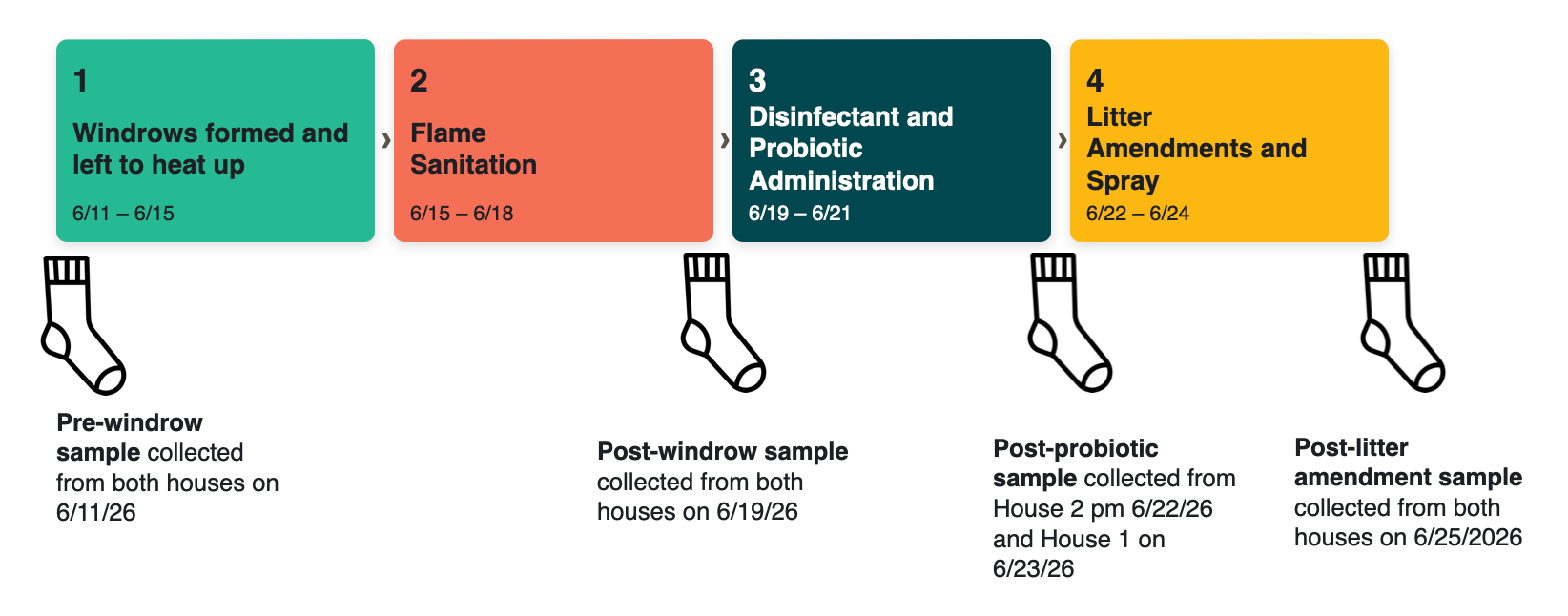
Windrows were formed and left to heat up, then turned and spread back out, but the center piles underperformed, reaching only 123°F, which prompted an added flame-sanitation step on the exposed hard pan. From there, hypochlorous acid was used to disinfect feed and starter pans, and a probiotic was applied. Litter amendments followed, with each house receiving a different combination: Derm-A-Tight, A7, Fastcap, and Tekko 10 in House 1, and A7, Iodine, Fastcap, and Tekko 10 in House 2. Birds were placed then placed about 5 days after the litter amendment and sprays were added.
The goal of testing after each intervention wasn't to find a single answer, but to build a step-by-step record of how the litter microbiome responded to each product and to identify what was changing conditions in the barn from what was simply adding cost.
In the next post, we'll walk through what that data showed, which interventions moved the needle, which ones didn't, and what it means for how this producer approaches her next flock.
If you're managing between-flock interventions and want to know whether they're working, reach out to us at hello@barnwellbio.com.
.jpg)

.jpg)