



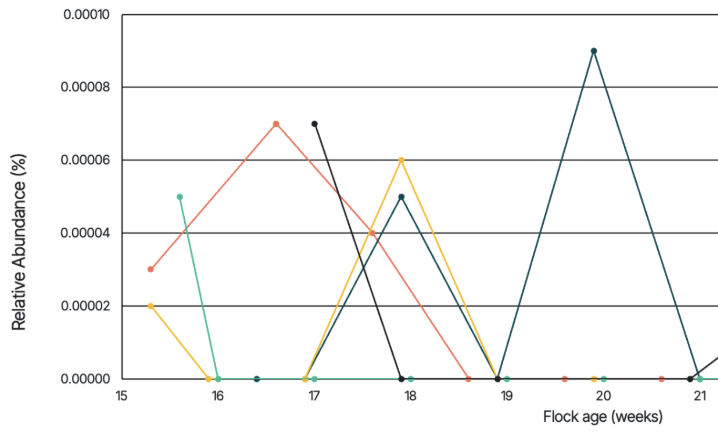
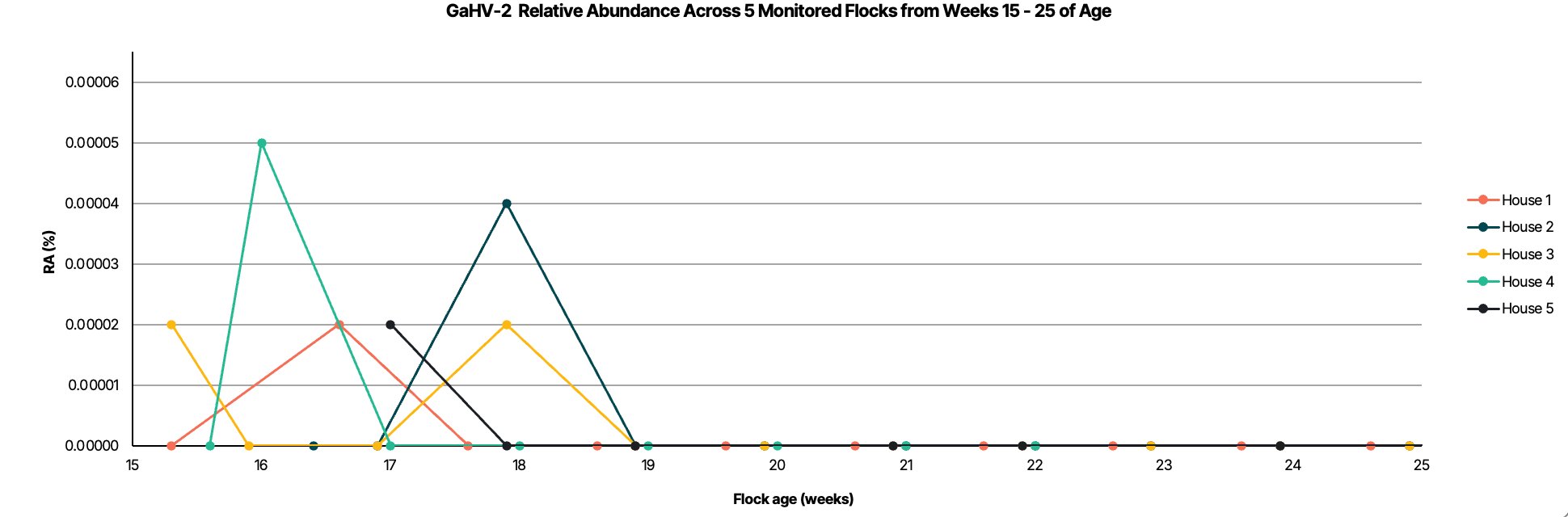
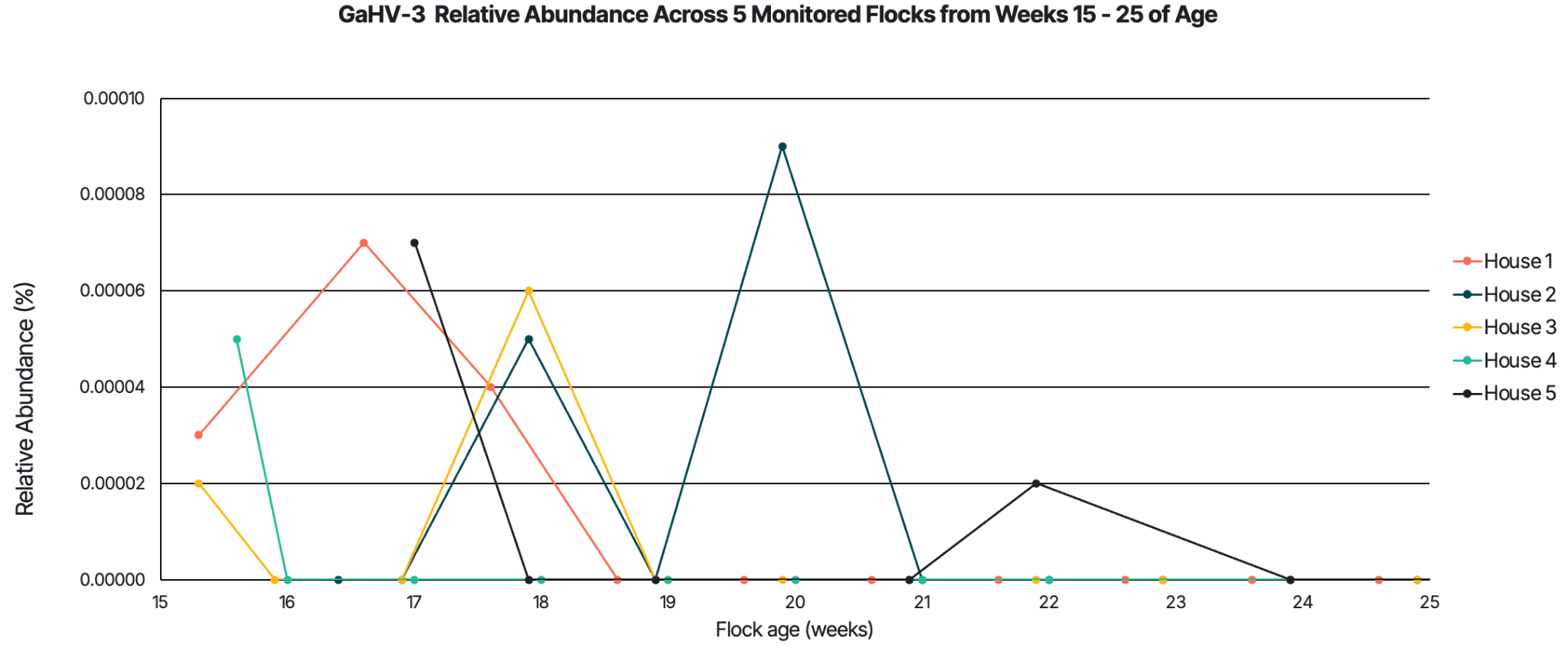
When we look at pathogen surveillance data by flock age instead of by calendar date, patterns show up that would otherwise stay hidden across different farms, seasons, and placement schedules. One of the clearest examples we see is what happens with two closely related viruses, gallid alphaherpesvirus 2 and gallid alphaherpesvirus 3, right around 15 to 17 weeks of age. That's the window when most pullets are moved from the rearing house into the layer house, and lining flocks up by age instead of by date, that spike shows up repeatedly.
Why Marek's Disease Matters
Marek's disease has been one of the costliest diseases in poultry production. It causes lymphoid tumors, paralysis, and immunosuppression, and before vaccines it could result in high morbidity and mortality throughout a flock. Fortunately, efficacious vaccines introduced in the late 1960s brought the visible disease under control. However, the virus itself never went away. It's still one of the most ubiquitous pathogens in commercial poultry, and it still causes industry losses through occasional vaccine breaks, condemnations at processing, and the immunosuppression it causes in birds even if the tumors never develop. This is also a virus with a track record of turning a background finding into a real problem if other pathogens are present and causing issues.
The Viruses Behind the Disease
GaHV-2 and GaHV-3 are both members of the Marek's disease virus family, the genus Mardivirus. GaHV-2 is Marek's disease virus serotype 1, the naturally oncogenic strain that causes classic Marek's disease. GaHV-3 is Marek's disease virus serotype 2, a naturally mild strain that doesn't cause tumors on its own and is one of the viruses used in combination Marek's vaccines. Both belong to the same viral family and behave the same way in the bird: they set up lifelong latency in white blood cells, then periodically ramp back up and shed infectious virus out through the feather follicles into skin dander and house dust.
Why Placement Results in Increased Shedding
Moving pullets to the layer house is a stressful event, even when it's done well. Birds go through handling and transport, a change in house, temperature, humidity, and equipment, and often a dip in body condition.
Stress raises corticosterone, the primary stress hormone in birds, which disrupts the immune system right when it needs to be keeping latent viruses in check. Researchers point to this same mechanism across herpesviruses generally, and it's been measured directly in Marek's disease virus. Challenge studies show that when a bird's immune system is under pressure, shedding of Marek's-family viruses already present in the body can jump dramatically, with one study finding herpes virus shedding increase roughly 38-fold and GaHV-3 shedding increase roughly 75-fold after birds were challenged with virulent virus (Islam & Walkden-Brown, 2007). Placement stress results in a pressured immune system allowing birds to shed more of what they're already carrying.
The Role of Vaccination
Almost every commercial pullet has already been vaccinated against Marek's disease, usually in ovo or at day of hatch and often with a combination of HVT and the Rispens strain. Vaccination protects against tumors, paralysis, and the immunosuppression that comes with Marek's disease. It does not prevent infection with the virus or stop viral shedding. Vaccinated birds still get infected with field strains, still carry the vaccine strains themselves, and still shed both through the feather follicles
On a vaccinated flock, detecting GaHV-2 or GaHV-3 in a placement-week sample is expected background, not automatically a sign that something has gone wrong. The vaccine isn't designed to remove the virus. It's designed to prevent clinical signs in the birds even while they carry the virus.
Why this is Clear looking at Flock Age
None of this shows up cleanly if pathogen data only gets looked at by calendar date, because different flocks get placed on different days and the pattern washes out. Lined up by age instead, the same curve appears across flock after flock: a rise around 15 to 17 weeks, followed by a decline over the next few weeks as birds settle into the new environment and stress hormones normalize. This consistency is what makes it possible to tell a normal adjustment curve apart from a signal that keeps climbing past the point where it should be leveling off, or keeps appearing at high levels time and time again, which is the pattern worth digging into further.
The takeaway
A spike in Marek's-family virus right at placement usually comes down to biology. Transport and environmental stress cause a temporary dip in immune control, and that dip lets the virus the flock was already carrying shed at higher levels. Tracking that pattern by flock age rather than by date is what makes it visible, and once it's visible, it turns into one of the more predictable curves in poultry pathogen surveillance rather than a mystery. It also means you can spot when a rise falls outside the normal timeframe or keeps climbing instead of settling down, and flag that for a closer look.
References
Islam A, Walkden-Brown SW. Quantitative profiling of the shedding rate of the three Marek's disease virus (MDV) serotypes reveals that challenge with virulent MDV markedly increases shedding of vaccinal viruses. Journal of General Virology. 2007;88(8):2121-2128.
If you're seeing signs of disease at across flocks, reach out to us at hello@barnwellbio.com to get a better age-adjusted comparison and deeper microbiome analysis.
.jpg)

.jpg)

.png)
