
Coccidiosis is one of the most common topics producers and veterinarians ask us about when they're looking at their dashboard. They want to know whether an increase in Eimeria is something to worry about or just normal cycling. Eimeria species show up in poultry litter all the time, whether from live vaccine cycling, environmental carryover, or an active clinical challenge. Barnwell Bio data can tell you which Eimeria spp. are present and how their relative abundance compares to what we typically see. Here are three examples where the signal provided important insights that helped producers make decisions to support their flocks through coccidiosis breaks.
Three Coccidiosis Examples
Eimeria was Present before the Birds Arrived
In one broiler operation, we sampled at four points in the clean-out sequence: before windrowing, after windrowing, after a probiotic was applied, and after a litter amendment. Eimeria tenalla was at a medium alert at every sampling point. Windrowing brought the relative abundance down across most genera of organisms that were detected, but Eimeria tenella, praecox, and maxima held, and the windrows did not reach the expected temperatures. Oocysts are hardy, and heat is one of the main tools for knocking them back in the litter. Our alerts showed Eimeria still sitting above its typical level seen in a healthy poultry barn when the house should have been at its cleanest.
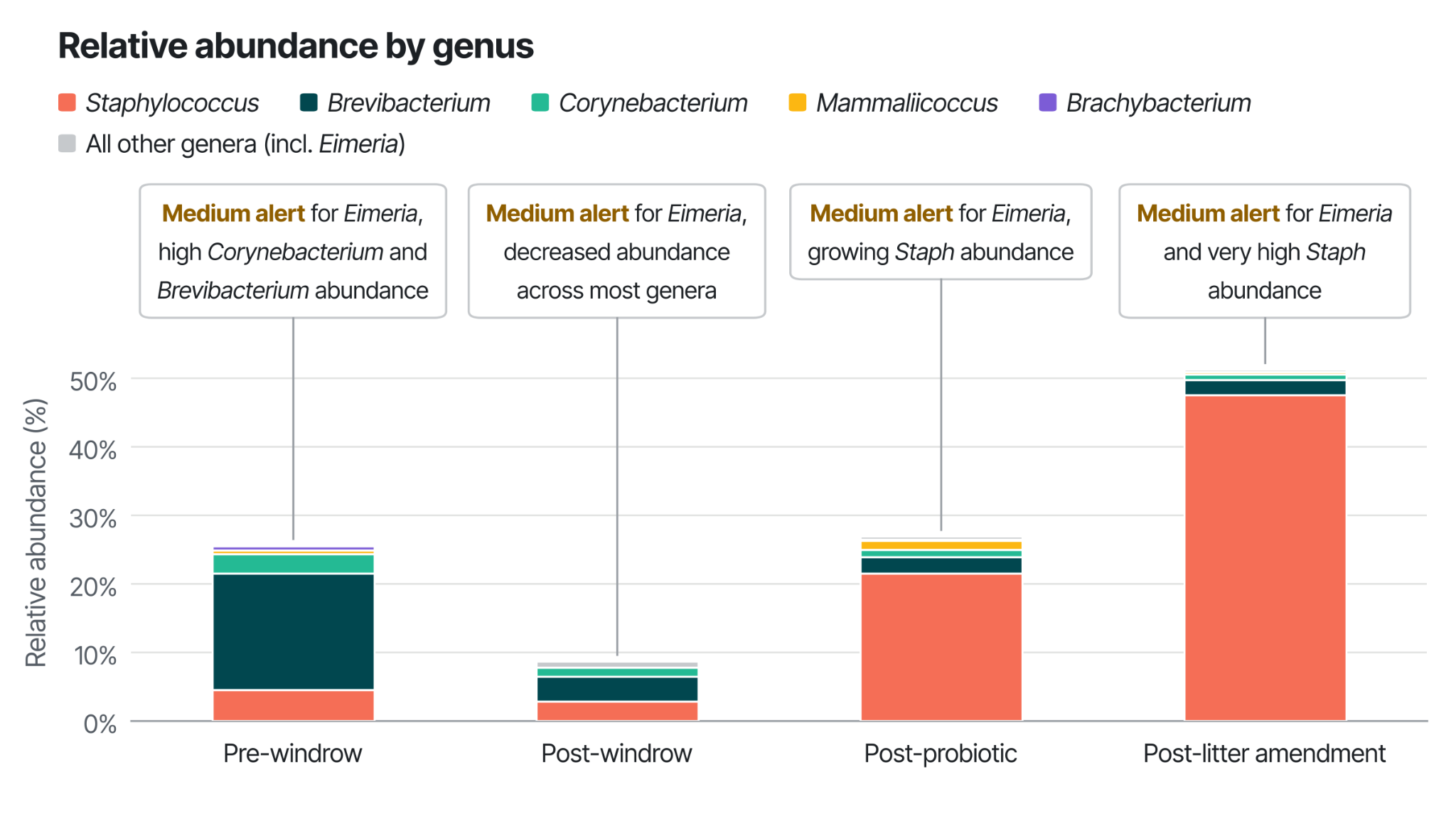
About a month into grow-out, after this cleaning and disinfection process, the flock broke with necrotic enteritis. That timing fits a well-known pattern, since coccidial damage to the intestinal lining sets the stage for Clostridium perfringens to take hold. What made the signal meaningful was when it appeared. The Eimeria alerts were there at every clean-out step, weeks before the losses and before a single chick was placed, and it pointed to a specific problem: oocysts likely survived the clean-out.
That gave the producer something concrete to act on. Through Barnwell Bio testing, they knew that the current products used were not working fully, and this allowed them to save on application costs and to re-evaluate products that would work better on their operation. For the next flock, they stepped up their C&D procedures, doing a complete clean-out, adding further testing, and seeking out a product expected to kill oocysts.
Eimeria in the Pullet House Before Clinical Signs
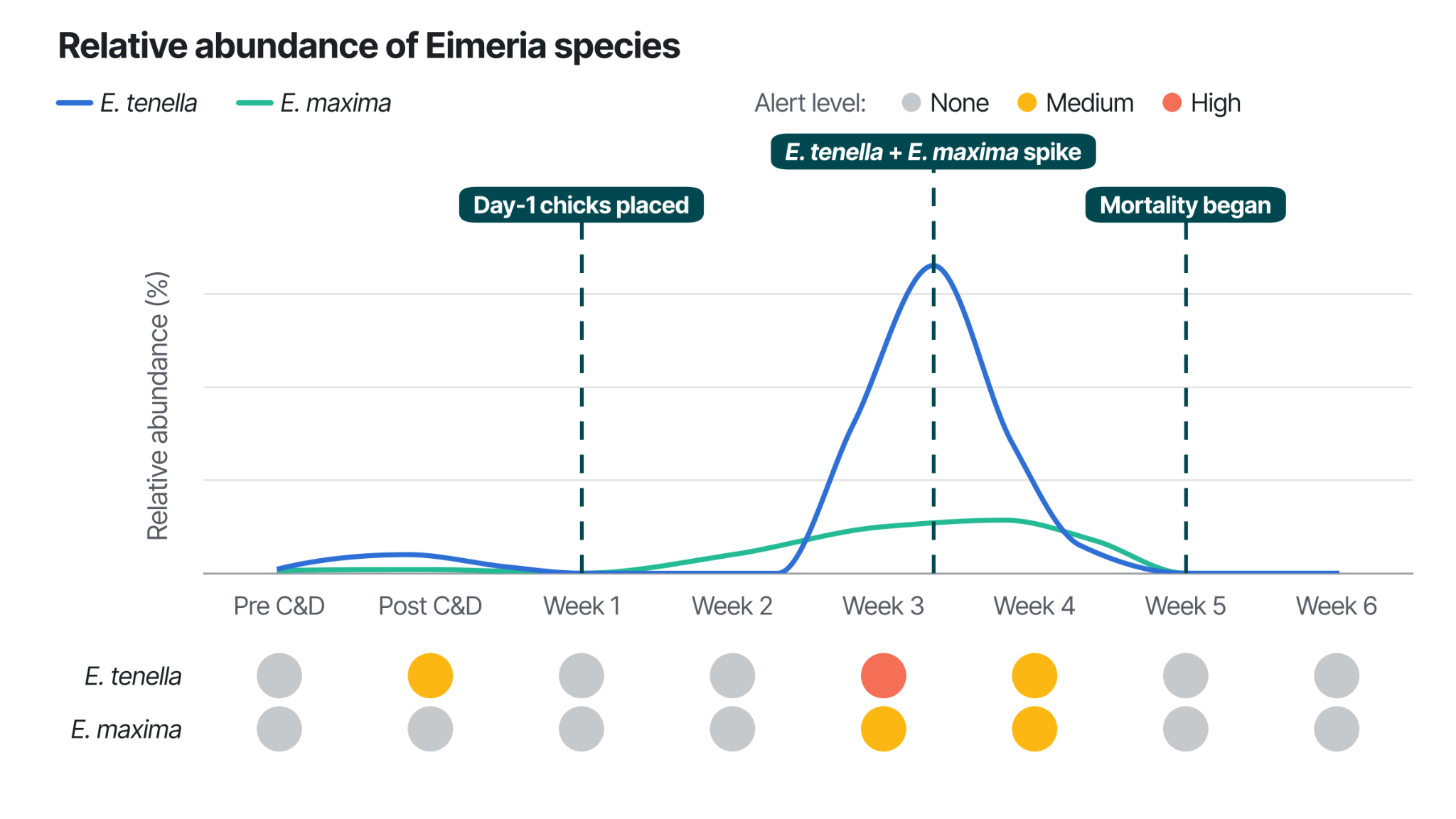
In a pullet house, we detected E. tenella and E. maxima above its typical level when the birds were three weeks of age and flagged at a medium alert. There was an alert in the pre-placement sample. These alerts continued through week 4, and at week 5 mortality began to spike. Necropsy was completed and fit with coccidiosis, likely due to E. tenella. Two pulse doses of amprolium were quickly started in the house.
Eimeria and a Secondary Infection Rising Together
The last example comes from a layer facility that uses a live coccidiosis vaccine, so Eimeria cycling is expected. For most of the flock's life, the Eimeria species we track stayed close to their usual levels. Starting at week 35 of bird age, that changed. Several species broke from regular cycling into medium alerts and then high alerts, with E. tenella and E. maxima showing the biggest jumps and E. acervulina climbing alongside them. In that same sampling period, Clostridium perfringens, Enterococcus cecorum, and E. coli rose too.
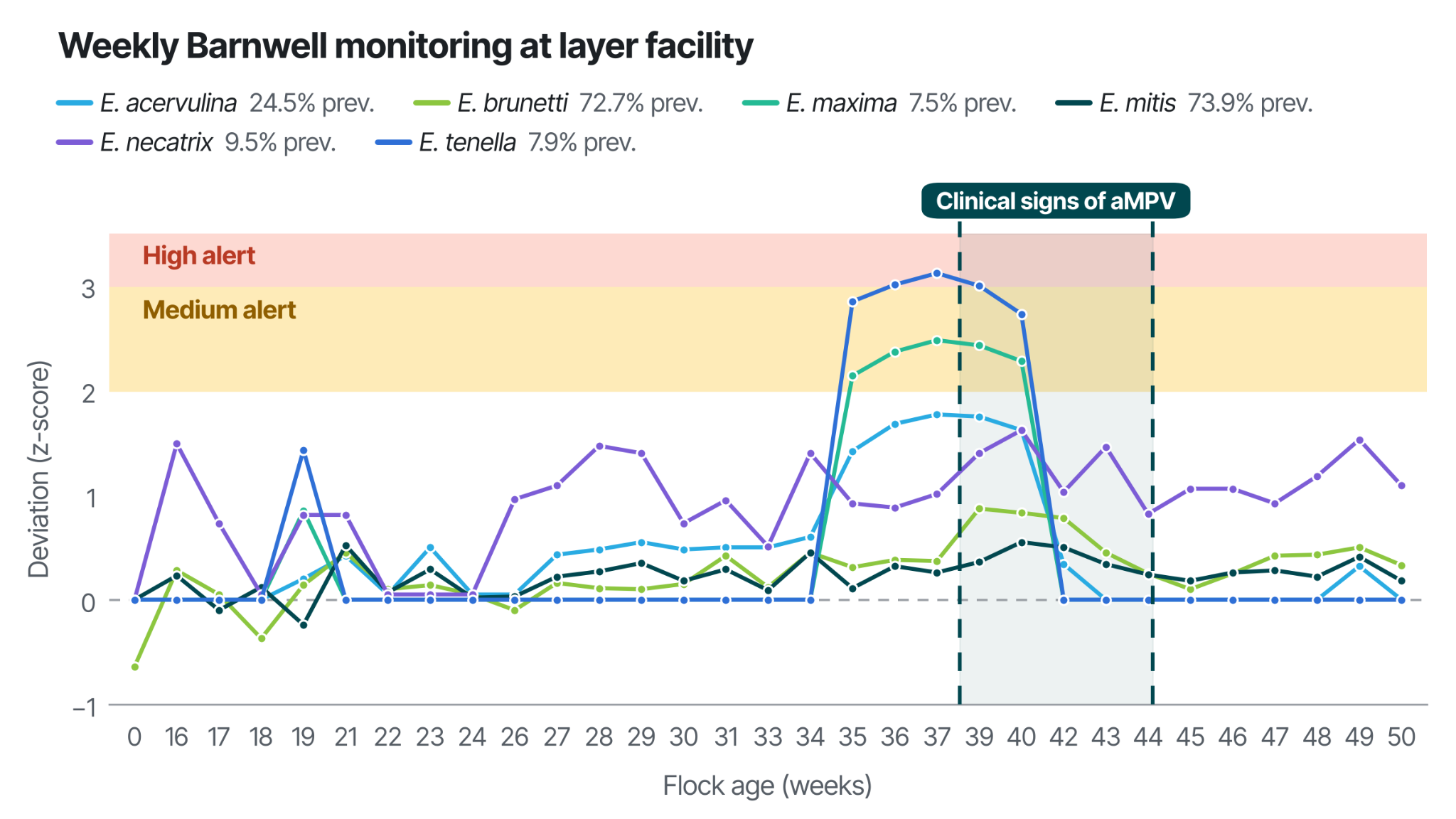
The flock was also positive for avian metapneumovirus (aMPV) just slightly. A flock that's fighting a virus is under stress, and that can lead to Eimeria over cycling. The alerts held for roughly five weeks and dropped back to baseline around week 42. The producer was able to see Eimeria, secondary bacterial infections, and an RNA virus move together, a few weeks before the clinical picture was clear. This gave the team an early and more complete view of what the flock was dealing with, to help them provide supportive treatment.
Patterns That Help You Read the Signal
Looking across layer, pullet, and broiler operations, two patterns stood out. First, the age of the birds tended to shape which species triggered alerts, and, second, other enteric pathogens were often present at the same time. These are observations from the Barnwell data as a whole and not a rule for every flock, but they are a useful starting point for reading your own data.
The Age of the Birds Shapes Which Species Increase
Timing was one of the most consistent findings. In young pullets, E. brunetti and E. acervulina tend to show up first, around days 7 to 14, and are often followed by E. mitis and E. necatrix. Around day 21, E. tenella and E. maxima join, and they are usually the species that push a flock into an alert. In the flocks we reviewed, alerts most often began between days 21 and 28.
This sequence matches what the vaccine schedule predicts. After vaccination, oocysts appear on the litter in a set order. Each species then cycles about weekly, with the heaviest shedding around days 13 to 16 for E. acervulina and E. brunetti, around day 17 for E. maxima and E. tenella, and around day 19 for E. necatrix. By about days 15 to 28, depending on the species, birds are protected and shedding is low.
The window when E. tenella, E. maxima, and E. necatrix rise, roughly days 14 to 28, overlaps with expected vaccine cycling, so an alert in that window should be interpreted with caution and in the context of any clinical signs. Additionally, we see a similar pattern when pullets are moved into layer houses and stress increases. There can be a second wave of E. acervulina, E. tenella, and E. maxima potentially wrestling in clinical signs during the first three to four weeks after transfer, before settling back down.
Other Enteric Pathogens Tend to Be Present
Eimeria rarely moves alone. As in the layer example, increases in Clostridium perfringens, Enterococcus cecorum, and E. coli were often seen around the same time as Eimeria alerts. Because coccidia damage the intestinal lining, they set the stage for secondary bacterial enteric infections.
In young pullets, chicken parvovirus and aviadenovirus appeared from about week 3, around the same time we saw Eimeria alerts. These viruses are also common at this age, so we can't tell whether they are linked to the coccidia or simply reflect the age of the birds. We therefore read them as pathogens that tend to show up together and not as proof of cause. Even so, seeing several pathogens rise at once, especially ones that can weaken the immune system of young birds, is a good reason to closely watch the flock for other potential outbreaks.
What to Do With the Signal
First, check Eimeria levels after clean-out and before placement, then watch closely for clinical signs between days 14 and 28, when E. tenella and E. maxima typically appear. Second, treat a medium or high Eimeria alert as a prompt to review the house, the vaccine program, and the other pathogens rising with it. Third, keep a close eye on the flock and, if clinical signs of coccidiosis appear, treat with a coccidiostat if possible.
The Bigger Picture
An elevated Eimeria signal on its own doesn't tell you what to do next. Whether it reflects a live vaccine doing its job, carryover from a sanitation step that fell short, or a flock under pressure from a secondary infection depends on the context around it, including the age of the birds, flock history, and what other pathogens appear alongside it. In each example, the value was in seeing the signal early enough to act on it. Barnwell’s Alert Levels gave the producers and veterinarians a clearer read on where their flocks stood with coccidiosis and where they may be heading.
If you have questions about how these updates affect your results, if you are facing Eimeria challenges, or if you'd like a demo of our technology, reach out to us at hello@barnwellbio.com.