




One of the biggest questions with Barnwell Bio’s monitoring is knowing when a change in pathogen abundance truly matters. A pathogen may appear in a sample, but is that level unusual? Is it part of normal variation, or does it deserve closer attention?
To help answer these questions and more, Barnwell Bio has introduced Alert Levels. This is a new beta feature designed to highlight pathogen abundances that are higher than expected compared to what is typically observed across similar operations.
What Are Alert Levels and Why do they Matter?
Alert Levels flag pathogen abundances that fall outside the typical range observed across relevant Barnwell Bio samples. They are based on standard deviations from the historical average. A pathogen measuring two standard deviations above average receives a medium alert level, while one measuring three or more standard deviations above average is flagged as high alert level. Pathogens behave differently, so alert levels are specific to each one. A small increase may be meaningful for one microbe, while a much larger change may still be in the expected range for another. Essentially, Alert Levels give you a quick way to recognize when a reading stands out from what we have normally observed in the data. With Alert levels, users can focus their attention where the data suggests something unusual may be happening. This helps make the results more actionable and supports better conversations with veterinarians, production teams, and health personnel.
How Do Alert Levels Work?
For every pathogen we track, Barnwell Bio analyzes all relevant samples in our database to establish an average abundance. This builds a pathogen-specific reference range; like the way a laboratory establishes expected values for a blood test. When a new sample is processed, we calculate the relative abundance of each pathogen and compare it with the average observed across birds of the same type. At present, chicken samples are compared with other chicken samples, and turkey samples are compared with other turkey samples. As our dataset expands, thresholds and interpretation will continue to improve, with future refinements that may also account for management type, regional nuances, and more.
Based on the relative abundance and the comparison to the average, each pathogen falls into one of four categories:
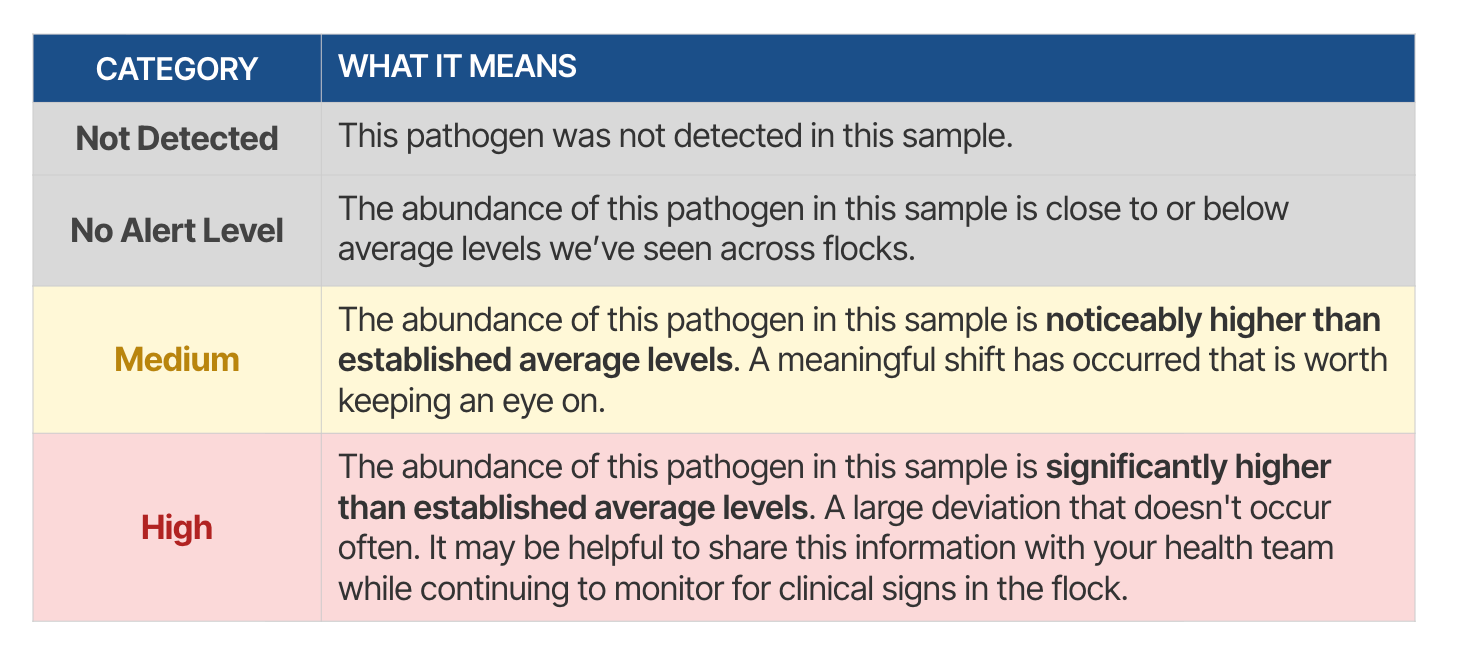
It is important to note that Alert Levels identify statistical outliers, not a diagnosis. A high alert does not automatically indicate disease, and no alert does not guarantee a healthy flock. These signals should always be interpreted alongside flock history, management conditions, clinical signs, and veterinary input. Your veterinarian or animal health team remains the key decision-maker for any health response.
However, they can help you quickly identify areas of concern and provide early warning of potential disease. Alert Levels add another layer of interpretation by helping users quickly identify when a pathogen signal falls outside what we normally expect. As I often say, you can’t manage what you don’t measure, and reliable interpretation is a critical next step in turning data into practical flock health decisions.
Alert Levels Already in Action
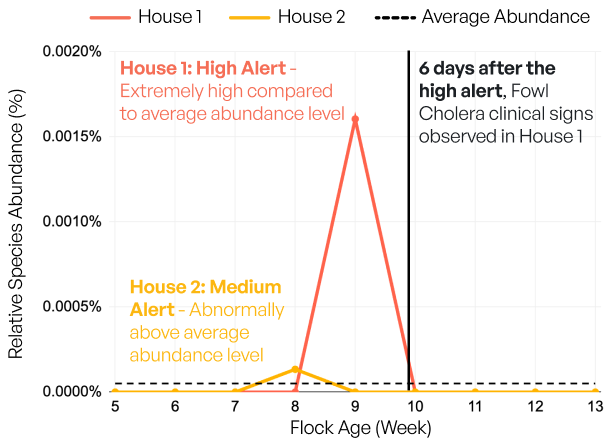
Our recent Fowl Cholera case study provides a real-world example of the value of Alert Levels, identifying a pathogen increase before an outbreak became clinically apparent. In this example, we partnered with a commercial turkey producer in Iowa for early disease monitoring. Barnwell saw an extremely small increase of < 0.002% of Pasteurella multocida relative abundance, which could normally go unnoticed. However with Alert Levels, this would be categorized as a significant high alert to flag for the producer. Six days after this increase, clinical signs of Fowl Cholera were identified in the house. This early signal does not replace clinical observation, but it gives producers and veterinarians a head start to monitor more closely, review management practices, and be prepared to quickly implement interventions to protect the flock.
Questions?
Want a live walkthrough of Alert Levels? Contact us at support@barnwellbio.com
.jpg)

.jpg)
.jpg)
