A producer wanted to answer the question - what impact is this specific product having on the microbial barn environment? This question has implications for whether it's the right tool for their intended use case, and whether it would be worth the investment. We were able to help get a clear signal and actionable next steps with just a few kits.
We sampled two locations. The first acted as a control location - it was an older flock at a different farm. Because it wasn't undergoing any new intervention at the time, it gave us a useful point of comparison, specific to their operations. The second was the treatment location, sampled once before and once after the product was applied.
The product itself was a competitive exclusion (CE) product. These products typically work by introducing a dense population of beneficial bacteria into the barn environment, so that pathogens have less available to establish themselves. This particular product was formulated to target Salmonella - an area where this producer has been looking to strengthen their toolset.
What the data showed
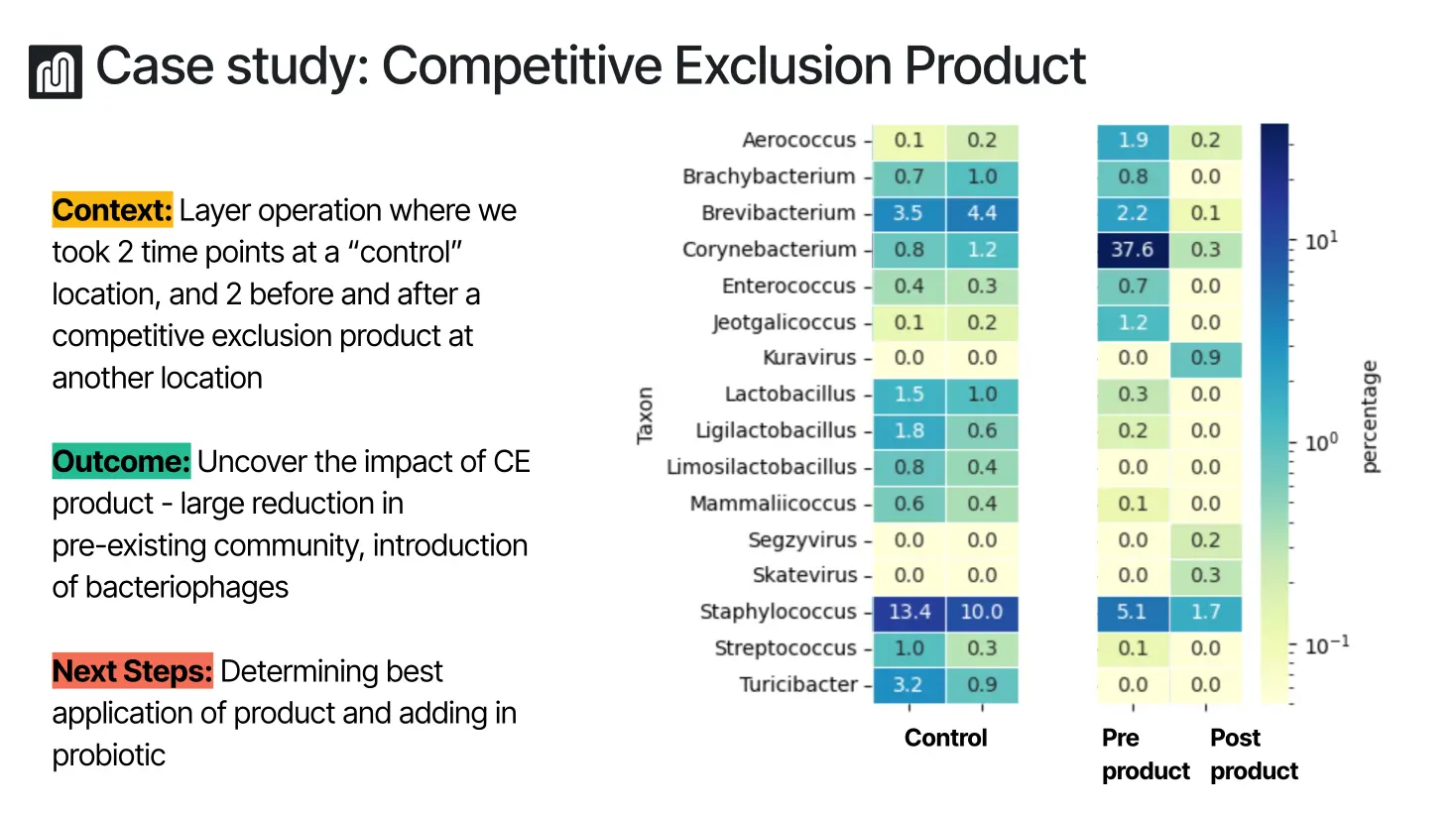
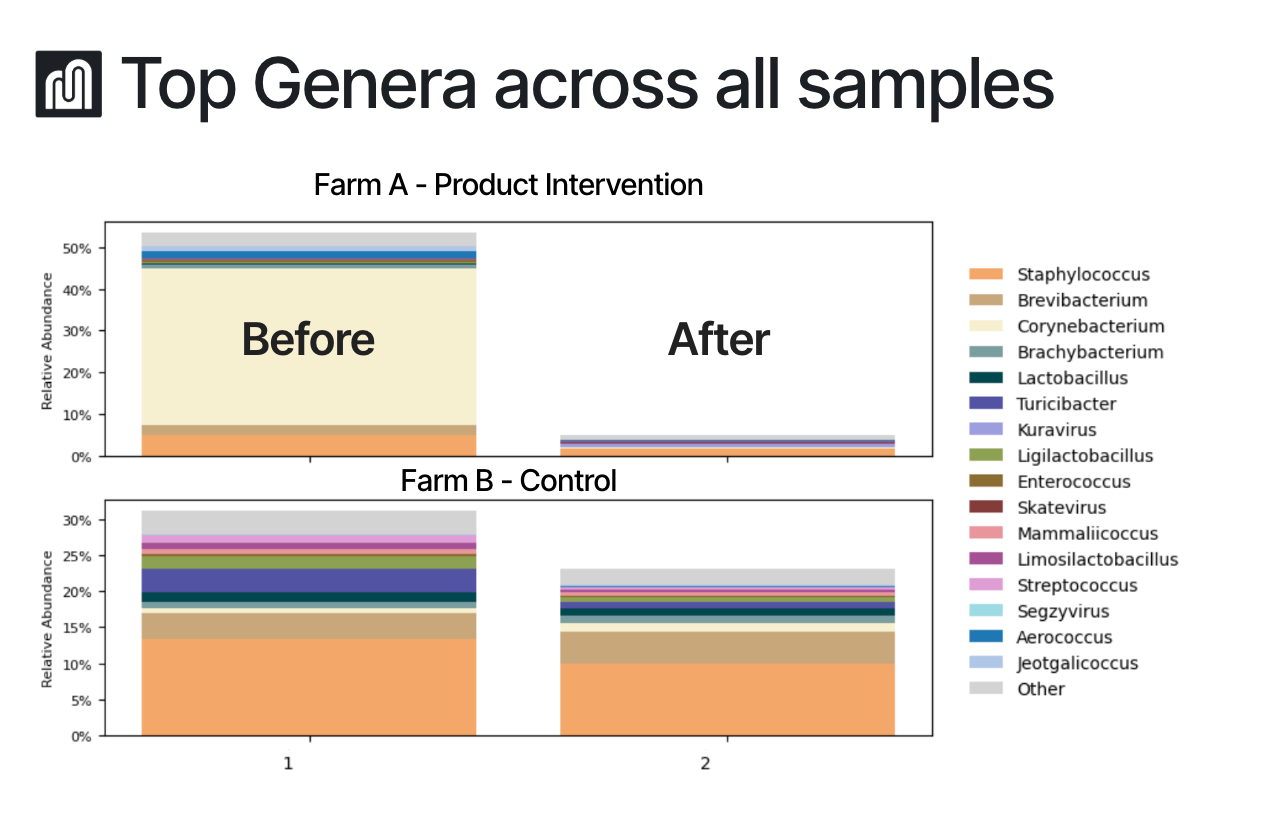
At the control location, the microbiome was relatively steady. The shifts we did see were consistent with an older, post-molt flock - a slight drop in microbes associated with healthy gut function.
The treatment location told a very different story. After the CE product was applied, we saw a large reduction across most of the pre-existing bacterial community. Genera like Staphylococcus, Brevibacterium, Lactobacillus, Ligilactobacillus, and Turicibacter all dropped sharply compared to baseline.
We also picked up something new in the post-treatment sample: bacteriophages that were not detected in the pre-treatment sample. These are viruses that target and kill bacteria like Salmonella.
What this means for producers
For an operation deciding how to use a CE product, this is useful, concrete information.
CE products are commonly undefined intestinal communities taken from adult birds, then amplified in fermenters. Because they are communities, they often work better than single-species probiotics, but it also means manufacturers themselves often don't have tight characterization of exactly what's in each batch. That's exactly why direct, barn-level monitoring is so valuable - it shows producers what a specific application actually did, rather than relying on the product's label claim alone.
In this case, we saw the product substantially reshaping the barn's existing microbial community. That's an important input when evaluating whether the product is doing what it's meant to do, and when thinking about timing, dosing, and location for future applications.
The appearance of bacteriophages post-treatment is also notable. Without knowing more about the specific composition, it's likely these were introduced by the product itself. It's also possible the phages had more room to proliferate once the existing microbial community was cleared out, giving them less competition.
What targeted investigations enable
This was a quick, low-lift way to get real insight into a product's impact in the barn. Based on these results, the producer’s next step was to explore pairing this CE product with a probiotic, to help ensure a healthy, diverse microbial community was re-established alongside it. Stay tuned for more from this work.
With a strategic handful of kits, you can get a meaningful answer on whether the treatments and interventions you're paying for are delivering the ROI you expect. Reach out to us at hello@barnwellbio.com if this sounds like something that would be useful to you!


.jpg)